
Growing Sea Buckthorn on One Acre: Varieties, Costs, Yields, and Real-World Management
Sea buckthorn has gained attention in Canada as a specialty crop, yet its potential on small acreage is often underestimated. Few perennial fruit crops can deliver reliable yields, tolerate harsh climates, and make economic sense on as little as one acre—if they’re planned properly from the start.
What sets sea buckthorn apart isn’t hype around superfoods or speculative markets. It’s a resilient plant with predictable production at maturity and a harvest structure that allows growers to extract value in more than one way.
This guide walks through what actually matters when growing sea buckthorn on one acre in Canada: variety selection, soil preparation, establishment costs, pruning strategy, irrigation choices, and harvest planning.
Best Sea Buckthorn Varieties for Growing an Acre in Canada
Choosing the right varieties is one of the most important decisions you’ll make, and it has long-term consequences for yield, harvest efficiency, and market suitability.
For Canadian conditions, priority should be given to varieties that combine:
cold hardiness
consistent yields
manageable growth habits
berry size suited to cut harvesting
High-performing female varieties commonly selected for one-acre plantings include cultivars known for 4–8 kg per plant at maturity under cut harvesting, with good regrowth after pruning. Male varieties should be selected specifically for strong pollen production and overlapping bloom times, not fruit traits.
Variety choice should also reflect your intended markets—whether bulk frozen berries, u-pick, or value-added processing.
Learn more about sea buckthorn varieties adapted to Canadian growing conditions, optimal planting layout, and how to distinguish male and female plants in our article Growing Sea Buckthorn 102.
A typical planting uses a 1 male to 8 female ratio, which balances pollination reliability with productive acreage. With practical spacing of 5 to 6.5 feet between plants and 13 to 14 feet between rows, this results in approximately 650 plants per acre—about 73 male plants and 577 female plants—strategically distributed across the field to ensure effective wind pollination.
| Spacing (ft) | Sq ft / plant | Plants / acre |
|---|---|---|
| 5 × 13 | 65 | ~670 |
| 5.5 × 12–13 | 66–72 | 600–660 |
| 6 × 13 | 78 | ~560 |
| 6.5 × 14 | 91 | ~480 |

How to Prepare Soil for Planting Sea Buckthorn on One Acre
Sea buckthorn is tolerant, but it performs best when soil preparation is taken seriously—especially on a one-acre scale where every plant counts.
The crop prefers:
well-drained soils
neutral to slightly alkaline pH
low to moderate fertility
Heavy clay, standing water, and compacted soils will limit establishment and long-term productivity.
It is strongly recommended to begin by collecting soil samples from several areas across the planned site and sending them for a full soil composition analysis. Understanding your soil’s pH, organic matter content, and nutrient profile early on helps prevent deficiencies that can lead to slow establishment, poor growth, and reduced yields.
Once soil test results are available, amendments should focus on correcting limitations rather than pushing growth aggressively. Sea buckthorn performs best at a pH between 6.5 and 7.5; if soils are acidic, agricultural (dolomitic) lime should be applied according to lab recommendations—often 1 to 2 tonnes per acre—well ahead of planting.
Improving organic matter to a moderate level (around 3–5%) with well-composted manure or compost, typically 5–10 tonnes per acre, helps improve soil structure, moisture retention, and microbial activity, especially in sandy or compacted soils.
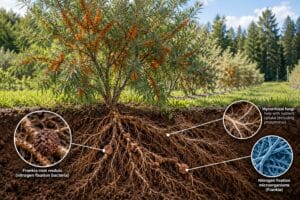
Nitrogen inputs should be kept low, as sea buckthorn fixes its own nitrogen once established; only a light starter application is justified in severely deficient soils during the first year.
Phosphorus and potassium should be applied only if soil tests indicate deficiencies, and micronutrients such as boron, zinc, or iron should be corrected in a targeted manner rather than applied broadly.
Above all, proper drainage must be ensured before planting, as sea buckthorn tolerates drought far better than waterlogged conditions, and no amendment will compensate for poorly drained soil.
The short version: fix drainage first, avoid over-fertilizing, and prepare for long-term root health rather than fast top growth.
Once established, Sea buckthorn is known to respond well to periodic watering with compost tea. Read our article here to learn about The Benefits of Using Compost Tea for Sea Buckthorn.
Cost Estimate for Establishing a one Acre Sea Buckthorn Orchard
A one-acre sea buckthorn orchard involves concentrated startup costs, followed by a lower, more predictable annual cost structure.
While exact numbers vary by region and inputs, typical cost categories include:
plant material (male and female shrubs)
soil preparation and amendments
weed control (mulch, fabric, or mechanical)
irrigation system installation
labour for planting and early maintenance
cold storage and fruit processing equipment
Most growers should budget for higher costs in the first two years, followed by significantly lower annual inputs once shrubs are established. Sea buckthorn is not a heavy feeder, fixes its own nitrogen, and requires less intervention than many fruit crops.
Importantly, harvest-related equipment can often be phased in gradually, aligned with market development rather than purchased upfront.

Top Irrigation Systems for Sea Buckthorn Farms in Canada
Sea buckthorn requires consistent moisture during establishment, but once roots are developed, it becomes relatively drought tolerant.
For Canadian conditions, the most effective irrigation systems on one acre are:
drip irrigation, which minimizes water use and weed pressure
low-pressure systems compatible with long row spacing
setups designed for early-season support rather than constant watering
Over-irrigation is more problematic than under-irrigation, particularly on heavier soils. Irrigation should support root establishment and stress management, not force excessive vegetative growth.
Designing irrigation with pruning and harvest access in mind saves costly adjustments later.
How to Prune Sea Buckthorn Bushes for Maximum Yield
Pruning is not optional with sea buckthorn—it is the mechanism that enables both yield and harvest efficiency.
The most effective systems are based on cut harvesting, where fruiting branches are strategically removed during harvest and allowed to regrow. When done correctly:
annual yields of 4–8 kg per mature female plant are maintained
regrowth remains productive
plant health is preserved long-term
After the initial cut harvest, a significant quantity of berries remains on the plant. These berries can be hand-harvested without affecting yields in subsequent years; the limitation is not agronomic, but logistical. Hand harvesting is slower and more labour-intensive, which is why many growers overlook this second phase—not because it is harmful, but because it requires time and people.
By opening the canopy and reducing branch density, cut harvesting makes post-harvest hand picking or u-pick far more practical. On a one-acre orchard, opening to the public for self-pick can be an effective way to capture additional value while limiting direct labour requirements.
Used strategically, pruning becomes the foundation of a two-phase harvest system that increases total yield per acre without increasing plant stress. For a deeper dive into cut harvesting and pruning strategies, see the following resources:
Growing and Harvesting Sea Buckthorn: A Permaculturist’s Guide
Common Harvesting Methods For Sea Buckthorn: A Commercial Growers Guide
Yield Expectations on One Acre: What Is Realistic
With approximately 577 productive female plants, a mature one-acre planting can reliably produce:
2 to 4 tonnes of berries per year through cut harvesting alone
Additional berries through post-cut hand harvesting or u-pick
Total yield increases not by pushing plants harder, but by fully utilizing the fruit they already produce.
This flexibility is what allows a single acre to support wholesale markets, direct sales, and value-added product manufacturing—sometimes all at once.

Why One Acre Is Enough to Matter
Sea buckthorn doesn’t require large acreage to justify itself. It requires:
good planning
realistic expectations
and a harvest strategy that matches your labour and markets
The same acre can remain simple or become layered and complex over time. The crop doesn’t force a single model—it allows you to decide how far you want to go.
That’s what makes sea buckthorn unusually well-suited to Canadian growers working with limited land but long-term vision.