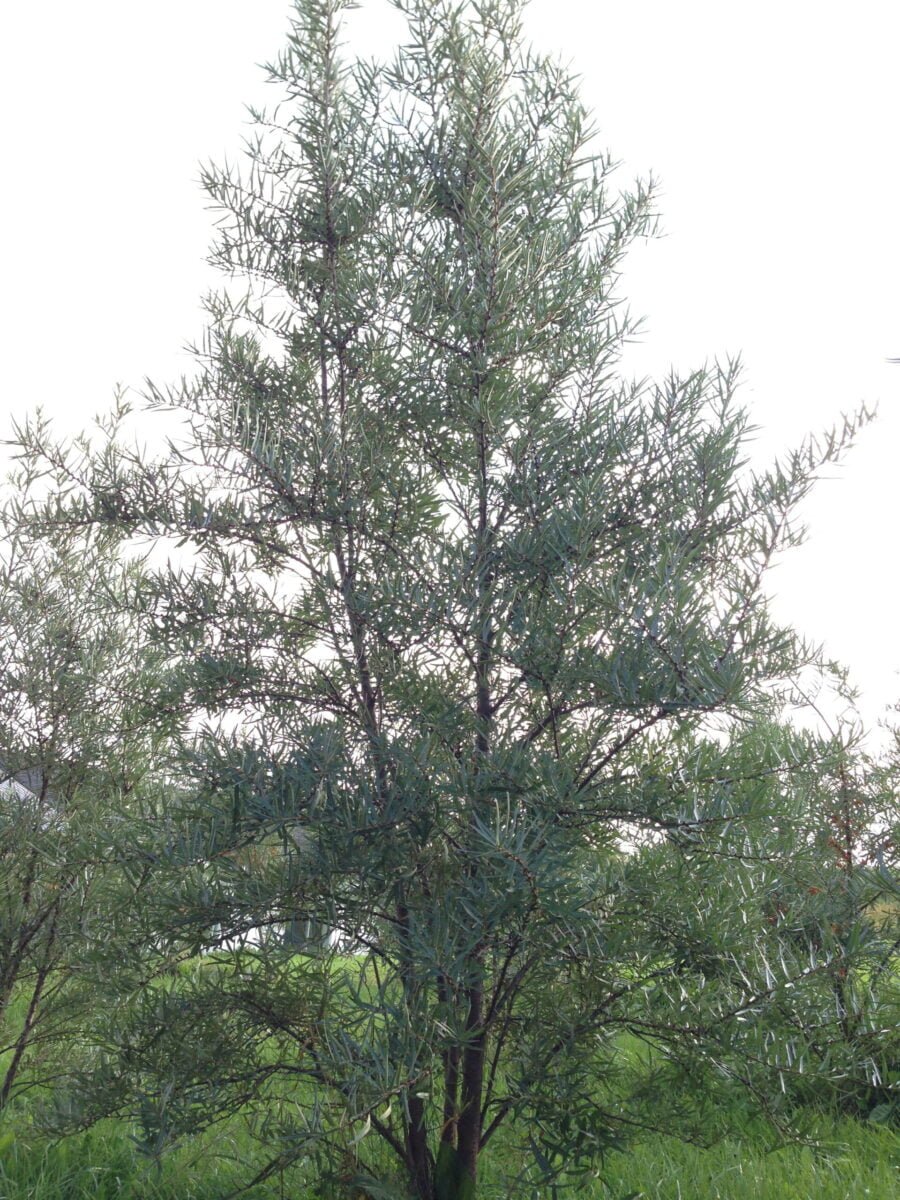

Using Inoculants in Permaculture
Modern agriculture often focuses on what can be added to the soil in the form of fertilizers, compost, and amendments. Yet some of the most important contributors to plant health are invisible to the naked eye.
Beneath every healthy crop lies a complex community of microorganisms that help plants access nutrients, tolerate stress, and grow more efficiently. Agricultural inoculants are designed to introduce or enhance these beneficial microorganisms, helping farmers and gardeners work with nature rather than against it.
While inoculants have been used successfully for decades in crops such as soybeans, peas, and clover, they are becoming increasingly important in regenerative agriculture, permaculture, and sustainable food production systems.
Sea buckthorn provides a fascinating example of how microbial partnerships can dramatically influence plant performance. This hardy shrub relies on specialized bacteria to capture nitrogen from the atmosphere, allowing it to thrive in soils where many other crops struggle.
What Are Inoculants?
Inoculants are products that contain beneficial microorganisms introduced to seeds, roots, growing media, or soil.
Unlike fertilizers, which directly supply nutrients, inoculants contain living organisms that help plants access nutrients more efficiently.
These microorganisms may include:
- Nitrogen-fixing bacteria
- Mycorrhizal fungi
- Phosphate-solubilizing bacteria
- Plant growth-promoting rhizobacteria (PGPR)
Once established around the root system, these organisms can form beneficial relationships with plants that improve growth and soil health.

What Are the Main Benefits of Using Inoculants in Agriculture?
The popularity of inoculants continues to grow because they offer numerous potential benefits.
Improved Nutrient Availability
Many nutrients already exist in the soil but remain unavailable to plants. Certain microorganisms can convert these nutrients into forms that roots can absorb more easily.
Reduced Fertilizer Requirements
Nitrogen-fixing bacteria can reduce dependence on synthetic fertilizers by supplying part of a plant’s nitrogen needs naturally.
Enhanced Root Development
Beneficial microbes often stimulate root growth, creating larger and more efficient root systems capable of exploring a greater volume of soil.
Improved Drought Tolerance
Some inoculants help plants access water more effectively and improve resilience during periods of limited rainfall.
Better Soil Health
Healthy microbial communities contribute to soil structure, organic matter cycling, and long-term fertility.
Increased Crop Establishment
Young plants often establish more quickly when beneficial microorganisms are already present around their roots.
How Do Microbial Inoculants Work in Agriculture?
Microbial inoculants work by establishing relationships between plants and beneficial microorganisms.
Different inoculants perform different functions.
Some bacteria capture atmospheric nitrogen and convert it into forms plants can use.
Others release phosphorus that is locked in soil minerals.
Mycorrhizal fungi extend microscopic threads far beyond the root zone, increasing the plant’s ability to absorb water and nutrients.
Some microorganisms even produce hormones that stimulate root growth or help suppress harmful pathogens.
The result is a more biologically active root zone that supports healthier and more resilient plants.

Types of Agricultural Inoculants
Nitrogen-Fixing Bacteria
Nitrogen is one of the most important nutrients required for plant growth.
Several groups of bacteria have evolved the ability to convert atmospheric nitrogen into plant-available forms.
Common examples include:
- Rhizobium
- Bradyrhizobium
- Azospirillum
- Frankia
Mycorrhizal Fungi
Mycorrhizal fungi form symbiotic relationships with plant roots.
The fungi receive sugars from the plant while helping roots access water, phosphorus, and other nutrients.
Phosphate-Solubilizing Bacteria
These microorganisms release phosphorus that would otherwise remain unavailable in the soil.
Plant Growth-Promoting Rhizobacteria (PGPR)
PGPR organisms can stimulate growth through hormone production, disease suppression, and nutrient cycling.
Sea Buckthorn: A Unique Example of Biological Nitrogen Fixation
Sea buckthorn is particularly interesting because it belongs to a relatively small group of plants known as actinorhizal species.
Unlike legumes, which form relationships with Rhizobium bacteria, sea buckthorn forms a symbiotic partnership with bacteria from the genus Frankia.
This relationship allows sea buckthorn to grow successfully in poor soils, sandy soils, degraded landscapes, and reclamation projects where nutrient availability may be limited.
It is one of the reasons sea buckthorn has become an important species for erosion control, soil improvement, and regenerative land management.
What Is Frankia?
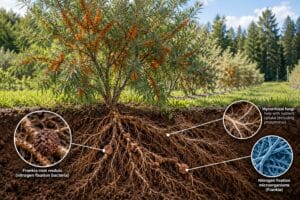
Frankia is a group of soil bacteria capable of fixing atmospheric nitrogen.
When compatible strains encounter sea buckthorn roots, they stimulate the formation of specialized structures known as nodules.
These nodules become miniature nitrogen-fixing factories.
Inside the nodules, the bacteria convert atmospheric nitrogen into ammonium compounds that the plant can use for growth.
In return, the plant supplies the bacteria with carbohydrates produced through photosynthesis.
This mutually beneficial relationship allows sea buckthorn to obtain nitrogen even in soils with relatively low fertility.
How Frankia Benefits Sea Buckthorn
Research has shown several advantages associated with successful nodulation.
Potential benefits include:
- Increased nitrogen availability
- Improved root development
- Faster establishment
- Greater biomass production
- Improved growth in poor soils
- Reduced dependence on nitrogen fertilizers
- Better performance on reclamation sites
Studies have demonstrated that inoculated seedlings often produce more nodules and accumulate greater amounts of nitrogen than uninoculated plants.
The greatest benefits are generally observed in soils where compatible Frankia populations are absent or limited.

Can You Buy Sea Buckthorn Inoculants?
Unlike soybean inoculants, commercial sea buckthorn inoculants are relatively uncommon.
There are several reasons for this.
Frankia is more difficult to culture than many agricultural bacteria.
Different strains vary in effectiveness, and compatibility can depend on environmental conditions and local soil characteristics.
As a result, most inoculation efforts occur in research programs, restoration projects, or specialized nurseries rather than through widely available commercial products.
How to Inoculate Sea Buckthorn Naturally
Although commercial products are limited, growers sometimes introduce Frankia through natural methods.
Using Soil from Established Plantings
Soil collected from healthy sea buckthorn stands may contain compatible Frankia populations.
Small amounts can be incorporated into planting holes or container mixes.
Using Root Nodules
Root nodules from healthy plants can be crushed and mixed with water to create an inoculation slurry.
Roots may then be dipped into the slurry before planting.
Preserving Existing Nodules
When transplanting sea buckthorn, retaining healthy root nodules can help maintain established microbial relationships.
Care should be taken to avoid excessive root damage during digging and handling.
Potential Drawbacks of Inoculants
While inoculants offer many potential advantages, they are not always a guaranteed solution.
Possible limitations include:
- Variable results between sites
- Limited availability of specialized inoculants
- Compatibility issues between strains and plants
- Additional handling requirements
- Storage challenges for living organisms
- Reduced effectiveness under unsuitable soil conditions
Poor drainage, soil compaction, and excessive nitrogen fertilization can all reduce the effectiveness of nitrogen-fixing relationships.
The Importance of Soil Conditions
Even the best inoculant cannot overcome poor growing conditions.
Beneficial microorganisms require:
- Adequate oxygen
- Good drainage
- Moderate moisture
- Suitable pH
- Organic matter
Sea buckthorn, in particular, performs best in well-drained soils where root systems can develop freely.
Heavy clay soils with poor aeration may limit both root growth and microbial activity.
Should You Use Inoculants?
For many gardeners and orchard growers, inoculation may not be necessary because beneficial microorganisms already exist naturally in the soil.
However, inoculants may provide greater value when:
- Establishing new orchards
- Planting on degraded land
- Producing nursery stock in sterile media
- Rehabilitating disturbed sites
- Growing in soils with low biological activity
The potential benefits are often greatest during establishment, when young plants are developing their root systems and microbial partnerships.
Final Thoughts
Inoculants represent one of agriculture’s most powerful biological tools. By introducing beneficial microorganisms into the root zone, growers can improve nutrient availability, strengthen plant health, and reduce reliance on external inputs.
Sea buckthorn offers an excellent example of how these natural partnerships work. Through its relationship with Frankia bacteria, this remarkable shrub can capture atmospheric nitrogen and thrive in challenging environments where many crops would struggle.
As interest in regenerative agriculture continues to grow, understanding inoculants and soil biology may become just as important as understanding fertilizers, irrigation, and crop management. Often, the most valuable workers on a farm are the billions of microorganisms quietly operating beneath the soil surface.

Frequently Asked Questions
What are the main benefits of using inoculants in agriculture?
Inoculants can improve nutrient availability, enhance root growth, increase drought tolerance, support soil health, and reduce fertilizer requirements by introducing beneficial microorganisms into the root zone.
How do microbial inoculants work in agriculture?
Microbial inoculants work by colonizing plant roots and performing beneficial functions such as nitrogen fixation, nutrient cycling, phosphorus solubilization, and improved water uptake.
What is the difference between an inoculant and a fertilizer?
Fertilizers directly supply nutrients to plants, while inoculants contain living microorganisms that help plants access nutrients already present in the soil or atmosphere.
Does sea buckthorn need inoculants?
Not always. Many soils already contain compatible microorganisms. However, inoculation may improve establishment and growth in sterile, degraded, or biologically inactive soils.
What bacteria help sea buckthorn fix nitrogen?
Sea buckthorn forms a symbiotic relationship with Frankia bacteria, which create root nodules and convert atmospheric nitrogen into plant-available forms.
Can inoculants replace fertilizer?
Inoculants may reduce fertilizer requirements, but they generally work best as part of an integrated fertility program rather than a complete replacement for nutrient management.