
If you’ve ever made fresh juice, you’ve probably wondered what to do with juice pulp once the liquid has been extracted.
That leftover pulp doesn’t necessarily have to go straight to the compost bin.
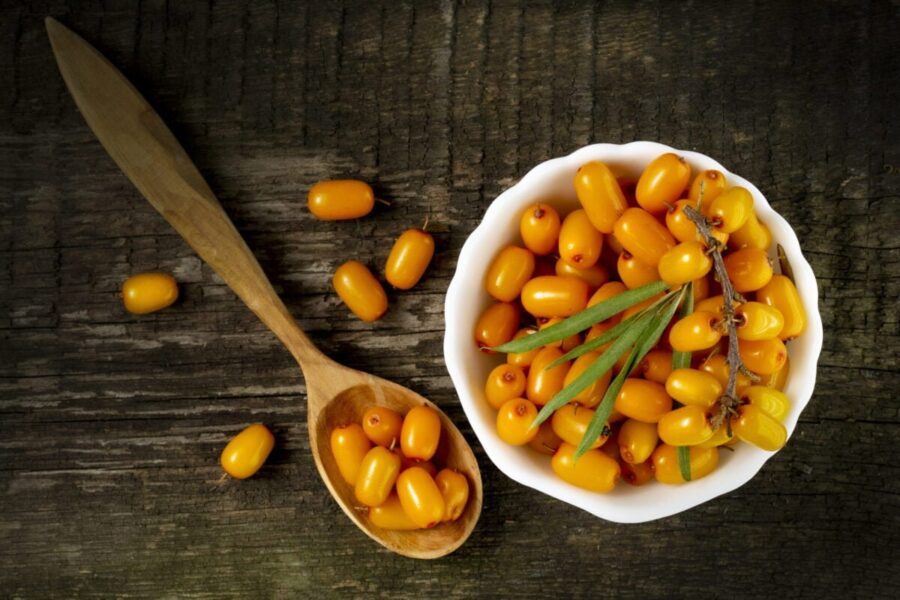
With sea buckthorn, the material left after juice extraction is called pomace. It consists mainly of fruit pulp, skins and seeds, and depending on how thoroughly the berries have been pressed or puréed, it can still retain plenty of tart sea buckthorn flavour and vibrant colour.
Sea buckthorn pomace does, however, have one characteristic that makes it different from the soft pulp left behind by apples, carrots or many other fruits: the seeds are quite firm.
That means adding a large spoonful of pomace directly to muffins, oatmeal or a smoothie isn’t always the most pleasant way to use it.
A better approach is often to strain out the seeds and then extract the remaining flavour.
Here are three simple ways to do exactly that using frozen sea buckthorn pomace: a herbal infusion, sea buckthorn-infused apple cider vinegar and a sweet-tart drinking shrub.
Later, we’ll also look at what can be done with the pomace after drying — and why even the seeds may deserve a second look.
What Is Sea Buckthorn Pomace?
Pomace is the solid material that remains after fruit has been pressed or processed for juice.
In the case of sea buckthorn, it can contain:
- remaining fruit pulp
- skins
- seeds
- residual juice
- naturally occurring fruit oils and other plant compounds
Research into sea buckthorn processing has identified pomace as a potentially useful food-processing by-product rather than simply waste. Dried sea buckthorn pomace has been investigated as a source of dietary fibre and other naturally occurring components, and researchers have experimented with grinding it into powder for food applications.
The exact composition of pomace will vary according to the berries and the way the juice was extracted. A lightly pressed pomace may still contain considerable pulp and moisture, while one produced through more intensive processing may be much drier.
That also means recipes made with pomace may need a little adjustment from one batch to another.

1. Sea Buckthorn Pomace Herbal Infusion
The easiest place to start is a hot infusion.
Frozen pomace can go directly into the saucepan, making this a convenient way to use small quantities straight from the freezer.
Mint and lemon balm complement sea buckthorn’s bright, tart flavour, while a small amount of hibiscus contributes additional fruitiness and colour.
Sea Buckthorn, Mint & Lemon Balm Infusion
Makes approximately 2 cups
Ingredients
- 100 g frozen sea buckthorn pomace, approximately ½ cup
- 2 cups (500 mL) water
- 1 tablespoon fresh mint leaves
- 1 tablespoon fresh lemon balm leaves
- 1 teaspoon dried hibiscus flowers
- Honey or maple syrup, to taste, optional
Directions
- Place the frozen sea buckthorn pomace and water in a small saucepan.
- Bring just to a simmer.
- Reduce the heat and simmer gently for approximately 5 minutes.
- Remove from the heat.
- Add the mint, lemon balm and hibiscus.
- Cover and allow to steep for another 10 minutes.
- Pour through a fine-mesh strainer, pressing the pomace lightly with the back of a spoon to extract the liquid.
- Sweeten with honey or maple syrup if desired.
Serve warm, or chill and serve over ice.
Make It Your Own
Sea buckthorn also pairs well with flavours such as:
- ginger
- lemongrass
- rosemary
- chamomile
- cinnamon
- cardamom
You can also add frozen sea buckthorn pomace to another loose-leaf herbal tea and strain everything together after steeping.
Tip: Taste your pomace. If it is relatively dry because most of the juice was extracted during processing, use a little more. If it is still very pulpy and intensely flavoured, you may need less.
Why Infusions Work So Well With Sea Buckthorn Pomace
Many articles about what to do with juice pulp suggest adding it to muffins, crackers, soups or smoothies.
Those options can work beautifully with soft fruit and vegetable pulp.
Sea buckthorn needs a slightly different approach because of its seeds.
Instead of trying to eat all of the solids, we can use water, vinegar or juice to extract the remaining flavour from the pomace, then straining the seeds away.
It gives us the best part of the leftover fruit without requiring anyone to enthusiastically chew their way through a spoonful of sea buckthorn seeds.

2. Sea Buckthorn-Infused Apple Cider Vinegar
Another useful way to extract flavour from leftover fruit pulp is with vinegar.
There is an important distinction here:
We are not fermenting the sea buckthorn pomace to make vinegar.
Instead, we are taking already-prepared apple cider vinegar and infusing it with sea buckthorn.
This is both simpler and considerably more predictable than attempting to make fruit vinegar from scratch.
Apple cider vinegar is especially well suited to fruit infusions because its flavour is softer than distilled white vinegar and pairs naturally with fruit. For flavoured vinegars, Washington State University Extension recommends using only commercially prepared distilled white vinegar, apple cider vinegar, or wine or champagne vinegar, following guidance from the National Center for Home Food Preservation.
Sea Buckthorn-Infused Apple Cider Vinegar
Ingredients
- 1 cup thawed sea buckthorn pomace
- 2 cups (500 mL) commercially prepared apple cider vinegar containing 5% acetic acid
Directions
- Thaw the sea buckthorn pomace in the refrigerator.
- Place it in a clean, sanitized, heat-resistant jar.
- Heat the apple cider vinegar to 190–195°F (88–91°C), just below boiling.
- Pour the hot vinegar over the pomace.
- Check the temperature with a food thermometer. The entire mixture, including the centre of the fruit solids, should remain above 165°F (74°C) for at least 1 minute and 12 seconds. This follows current University of Minnesota Extension guidance for hot-infused flavoured vinegar preparations.
- Close the jar with a clean lid.
- Store in a cool, dark location and allow the vinegar to infuse.
- Begin tasting after approximately 10 days. For a stronger infusion, it can be left for up to about 30 days.
- Strain thoroughly through a fine sieve.
- For a clearer finished vinegar, strain it a second time through a coffee filter.
- Transfer to a clean bottle.
For home use, refrigeration after straining is a sensible choice and helps maintain flavour and freshness. Penn State Extension likewise recommends refrigerated storage for flavoured vinegars for best quality.
How to Use Sea Buckthorn-Infused Vinegar
Use it anywhere you might ordinarily reach for apple cider vinegar:
- salad dressings
- vinaigrettes
- marinades
- sauces
- chutneys
- glazes
- cocktails
- mocktails
- sparkling-water drinks
One particularly easy option is to combine it with olive oil, Dijon mustard and honey for a bright sea buckthorn vinaigrette.
Know When to Discard It
If a flavoured vinegar develops mould, unexpected bubbling, unusual cloudiness or sliminess, discard it without tasting.

3. Sea Buckthorn Pomace Shrub
If you’ve never made a shrub, think of it as a concentrated sweet-and-sour fruit syrup made with vinegar.
It is diluted before drinking and works particularly well in sparkling water, cocktails and non-alcoholic drinks.
Traditional fresh-fruit shrubs often start by mixing fruit with sugar. The sugar draws juice from the fruit, producing a syrup that is eventually combined with vinegar.
But sea buckthorn pomace presents an obvious difference:
Most of the juice has already been removed.
If we simply cover pomace with sugar and wait for it to release a large quantity of juice, we may be waiting for something that isn’t going to happen.
Instead, we can first extract the remaining sea buckthorn flavour with a small amount of apple juice.
Apple contributes enough liquid to help extract the fruit while remaining mild enough to let the sea buckthorn stay at the centre of the recipe.
Sea Buckthorn & Apple Pomace Shrub
Makes approximately 2½–3 cups, depending on the pomace
Ingredients
- 1 kg frozen sea buckthorn pomace
- 300 mL unsweetened apple juice
- 500 g granulated sugar
- 600 mL commercially prepared apple cider vinegar, 5% acidity
Directions
- Place the frozen sea buckthorn pomace and apple juice in a saucepan.
- Heat gently until the pomace has thawed completely.
- Bring to a gentle simmer.
- Cook for 5–10 minutes, stirring and pressing the pomace occasionally to help release its remaining flavour.
- Remove from the heat.
- Pour the mixture through a fine-mesh sieve or jelly bag.
- Press firmly to extract as much liquid as possible.
- Set aside the remaining pulp and seeds if you intend to dry them rather than composting them.
- Return the extracted sea buckthorn-apple liquid to the saucepan.
- Add the sugar and warm gently, stirring until completely dissolved.
- Remove from the heat and allow the syrup to cool slightly.
- Stir in the apple cider vinegar.
- Transfer to a clean jar or bottle and refrigerate.
Allow the shrub to rest in the refrigerator for a day or two before using it. The flavours will become more integrated as it sits.
Keep refrigerated and use within approximately 2–3 weeks.
How to Drink a Sea Buckthorn Shrub
A good starting point is:
1 part shrub to 4–6 parts sparkling water
Pour over ice and adjust according to your taste.
The shrub can also be combined with:
- tonic water
- lemonade
- iced tea
- sparkling wine
- gin
- vodka
- non-alcoholic spirits
- cocktail bitters
- fresh herbs
Simple Sea Buckthorn Shrub Spritz
Combine:
- 30 mL sea buckthorn shrub
- 90 mL chilled Prosecco
- 60 mL sparkling water
- ice
- fresh mint or a thin slice of apple
Pour the shrub over ice, add the Prosecco and sparkling water, and stir gently. Adjust the proportions according to how tart and bubbly you like it.
Don’t Stop There: Drying Juice Pulp for Food Applications
Infusing isn’t the only answer to what to do with juice pulp.
Drying changes what pomace can become.
Removing the moisture makes it possible to grind sea buckthorn pomace into a powder that can potentially be incorporated into other foods.
Researchers have studied dried and milled sea buckthorn pomace in baked products. In one study, pomace remaining after juice extraction was dried, ground and incorporated into bread at different levels. Bread containing 8% pomace powder received the strongest overall sensory acceptance among the tested concentrations, while higher additions produced increasingly noticeable sour and bitter characteristics.
This opens up a very different group of possible applications for sea buckthorn pomace powder, including products such as:
- breads
- crackers
- muffins
- cookies
- granola
- spice mixes
- snack bars
- dry baking mixes
- smoothies and drink mixes
- savoury seasoning blends
Not every application will work at the same inclusion rate. Sea buckthorn is naturally assertive, and adding more isn’t necessarily better.
Its acidity, bitterness, fibre and particle size can all affect the flavour and texture of a finished product.
Drying Pomace at Home
If you’re experimenting at home, the goal is to remove the moisture thoroughly rather than merely forming a dry crust on the outside.
Spread the pomace in a thin layer on dehydrator trays and dry according to your dehydrator’s recommendations for fruit pulp, breaking up larger pieces as they dry.
Once completely dry and brittle, it can be ground.
Because sea buckthorn pomace contains seeds, a household grinder may produce a fairly coarse powder. Fine commercial milling provides considerably greater control over particle size.
For commercial food production, moisture content and water activity should be properly measured and validated before assigning a room-temperature shelf life.
What About the Seeds?
Here’s where the idea of using the entire fruit becomes particularly interesting.
Sea buckthorn seeds aren’t necessarily waste either.
They contain oil, and sea buckthorn seed oil is a distinct product from sea buckthorn pulp oil. Research describes mechanical cold pressing as one method of obtaining seed oil, while other commercial extraction technologies are also used.
If you regularly process sea buckthorn pomace, the seeds can potentially be:
separated → accumulated → thoroughly dried → sent for oil extraction
Research on sea buckthorn processing has specifically examined oil recovery from both pomace and separated seeds.
There is, however, an important qualification.
If producing oil is the ultimate goal, separating the seeds before prolonged vinegar infusion would be preferable to trying to recover them afterward.
Heat, moisture, storage and other pretreatments can influence the quality of oil subsequently extracted from sea buckthorn seeds.
Seeds strained from a brief water or juice extraction could potentially still be collected and dried for experimentation, but they shouldn’t automatically be assumed to be equivalent to freshly separated, properly dried seeds intended for oil production.
For serious oil recovery, the drying, storage and extraction process should be developed with a processor experienced in edible or cosmetic oils.
Getting More From the Fruit
Juice may be the first product we think about when processing berries, but it doesn’t have to be the last.
With sea buckthorn, the pulp, skins and seeds left after juice extraction still present possibilities.
Frozen pomace can provide flavour for an herbal infusion.
Apple cider vinegar can extract it into a versatile culinary ingredient.
A little apple juice, sugar and vinegar can transform it into a tart drinking shrub.
Drying can turn the pomace into an entirely different food ingredient.
And even the seeds can potentially become raw material for sea buckthorn seed oil.
Before throwing juice pulp away, it’s worth asking whether there might still be something useful — and delicious — left to extract.