What if a fruit-producing shrub could also help restore poor soil? Sea buckthorn has remarkable adaptations that allow it to thrive where other plants struggle, including the ability to capture atmospheric nitrogen and access nutrients locked within the soil.
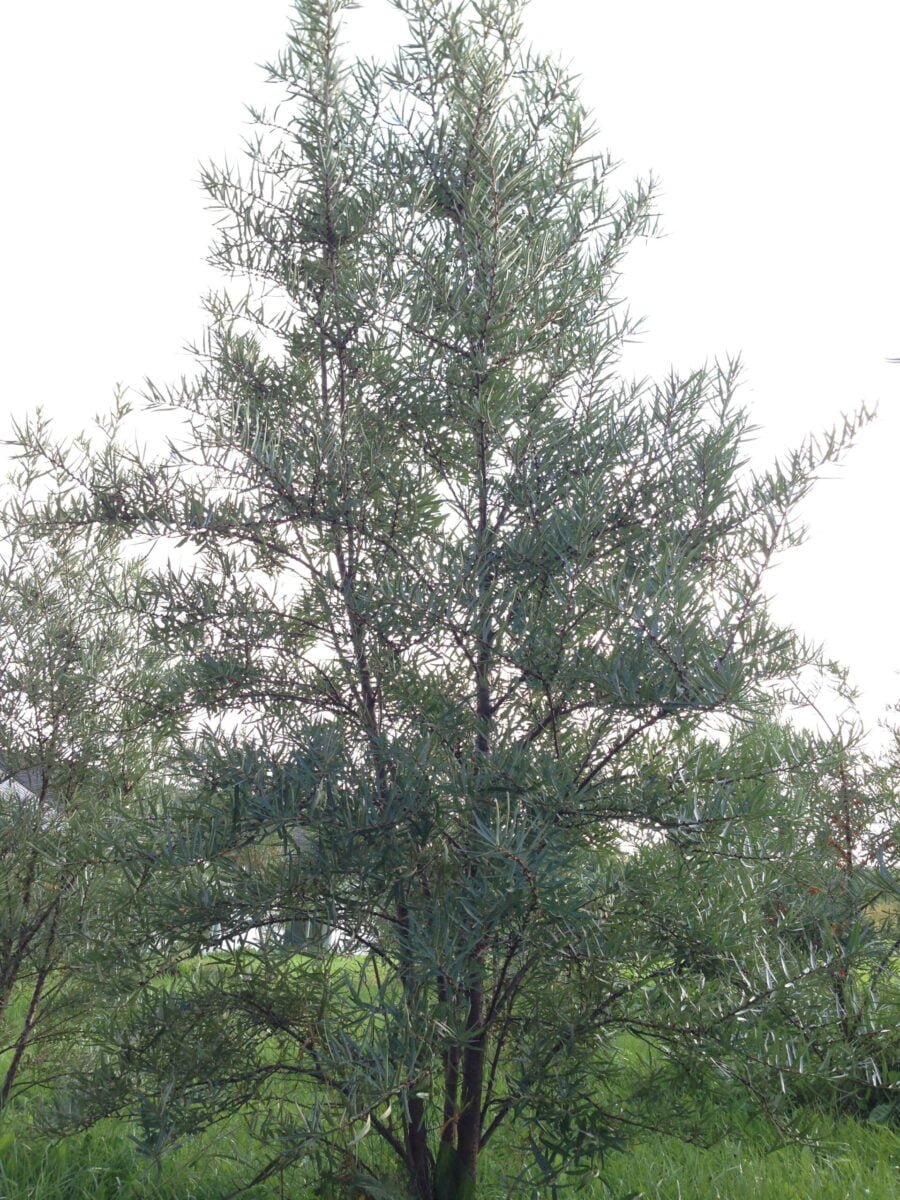
Sea buckthorn (Hippophae rhamnoides) is best known for its bright orange, nutrient-rich berries and exceptional hardiness. But beneath the soil, something equally fascinating is happening.
Unlike most fruit-producing shrubs, sea buckthorn can obtain nitrogen from the atmosphere through a natural process called nitrogen fixation. Its roots also possess specialized adaptations that help the plant access nutrients in challenging growing conditions.
These characteristics make sea buckthorn particularly interesting for gardeners, permaculturists and landowners looking to establish productive vegetation on nutrient-poor or degraded land.
But how does nitrogen fixation work, and can planting sea buckthorn actually improve soil fertility?
How Nitrogen Fixation Works in Sea Buckthorn
Nitrogen is essential for plant growth. It is a major component of chlorophyll, proteins and enzymes, yet despite making up approximately 78% of Earth’s atmosphere, most plants cannot use it directly.
Sea buckthorn has a natural advantage.
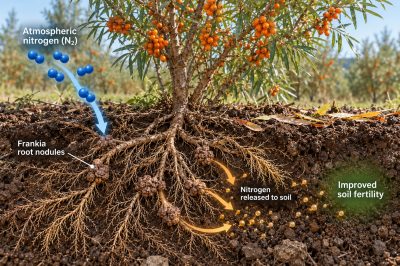
It belongs to a group known as actinorhizal plants, which form symbiotic relationships with specialized microorganisms capable of converting atmospheric nitrogen into a form plants can use.
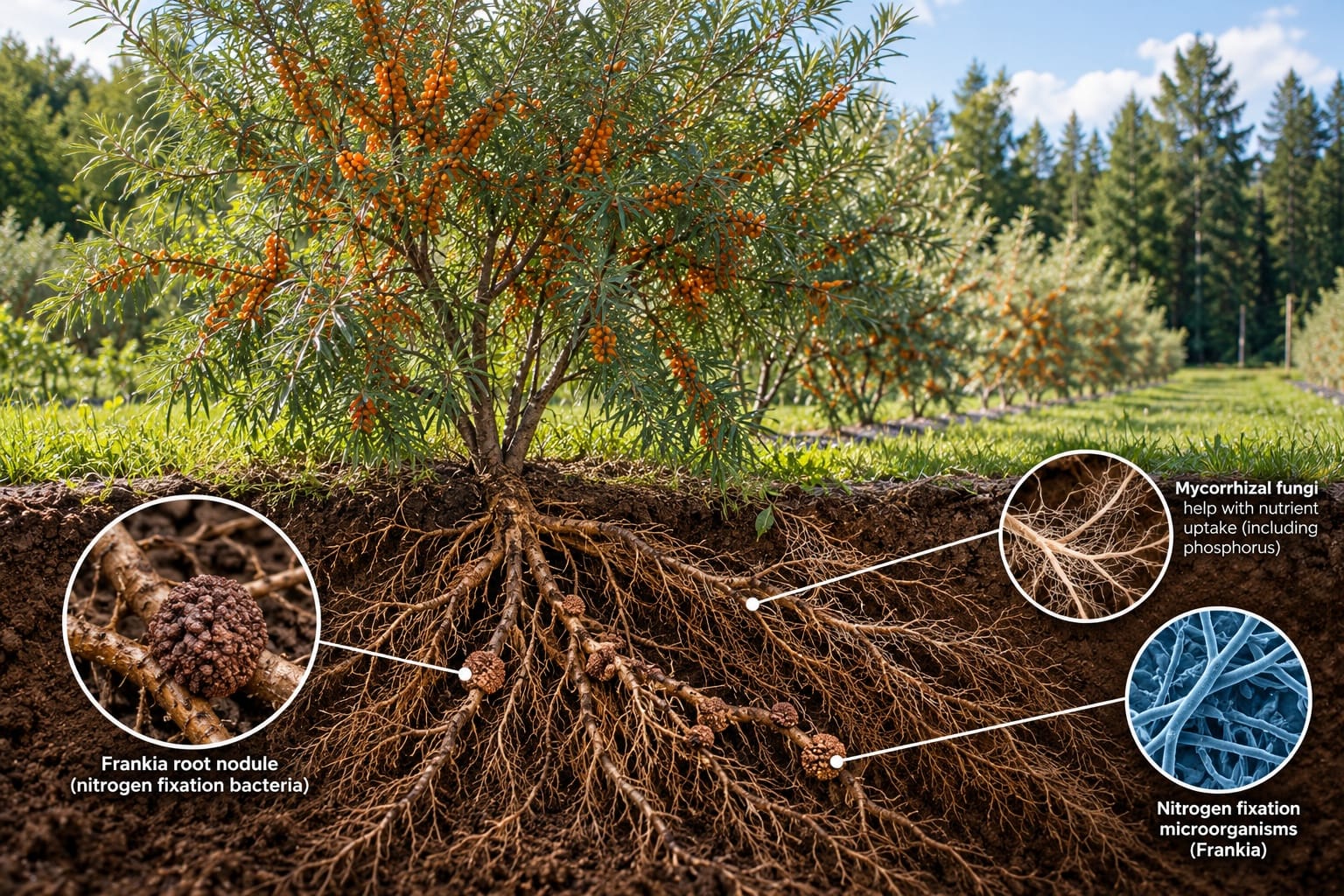
These nitrogen fixation microorganisms belong to the bacterial genus Frankia.
When compatible Frankia bacteria colonize sea buckthorn roots, they stimulate the development of specialized structures called root nodules.
Inside these nodules, the bacteria use an enzyme called nitrogenase to convert atmospheric nitrogen (N₂) into ammonia, which the plant can incorporate into compounds needed for growth.
In return, sea buckthorn supplies the bacteria with carbohydrates produced through photosynthesis.
This mutually beneficial relationship is known as biological nitrogen fixation.
It’s similar to the partnership between legumes, such as peas and clover, and their nitrogen-fixing bacteria. The difference is that legumes typically associate with bacteria called rhizobia, while sea buckthorn works with Frankia.
What Does the Research Show?
A 2007 study published in the Journal of the Japanese Society for Horticultural Science demonstrated the importance of nitrogen fixation bacteria in sea buckthorn development.
Researchers found that sea buckthorn seedlings inoculated with nitrogen-fixing root nodule material could grow normally under nitrogen-free conditions. Increased root nodule development was also associated with greater plant growth.
Interestingly, prolonged exposure to elevated nitrate concentrations inhibited nitrogenase activity, reducing the biological process responsible for atmospheric nitrogen fixation. [1]
This finding helps explain why sea buckthorn can thrive in nitrogen-deficient soils and why excessive nitrogen fertilization may be counterproductive.
Beyond Nitrogen Fixation: Sea Buckthorn’s Ability to Access Phosphorus
Nitrogen fixation is not sea buckthorn’s only adaptation to poor soil.
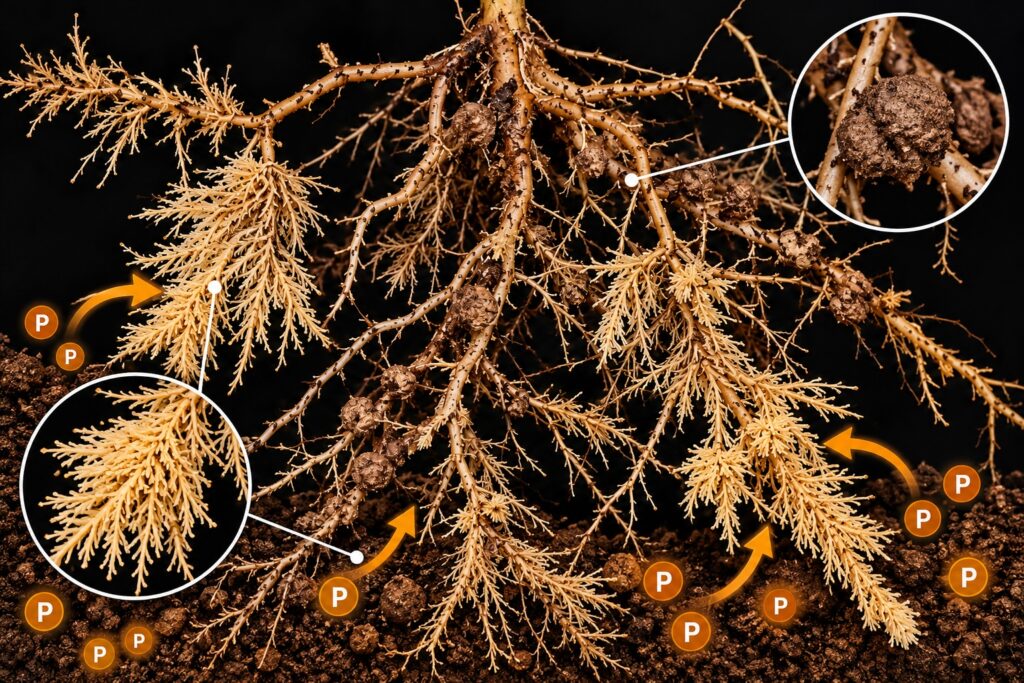
Research has revealed that its roots can develop specialized structures called cluster roots, which may improve access to phosphorus.
Phosphorus is essential for energy transfer, root development and fruit production. However, even soils containing substantial amounts of phosphorus may have limited quantities available for plant uptake.
This is because phosphorus readily binds to minerals such as calcium, iron and aluminium, forming compounds that plants cannot easily absorb.
Certain plants have evolved mechanisms to overcome this limitation, including developing dense clusters of fine roots and releasing organic compounds that help mobilize soil phosphorus.
The Discovery of Cluster Roots in Sea Buckthorn
In 2015, research conducted at the Swedish University of Agricultural Sciences examined how sea buckthorn roots responded to nutrient deficiencies.
The researchers found that low availability of phosphorus, nitrogen and iron influenced root development and promoted the formation of cluster roots.
These structures consist of numerous short lateral roots that increase contact with the surrounding soil.
Researchers also identified malate, an organic acid associated with phosphorus mobilization, in these specialized roots. [2]
Organic acids can interact with soil minerals and help release phosphorus into more accessible forms.
One particularly interesting discovery was that a wild sea buckthorn accession originating from infertile soil produced more cluster roots than certain cultivated genotypes, including the variety Sunny.
This suggests that different sea buckthorn genotypes may vary in their adaptations to nutrient-poor environments.
Although these findings provide evidence of specialized nutrient-acquisition mechanisms, further field research is needed to determine how much additional phosphorus sea buckthorn can access through these adaptations.
The Hidden Role of Beneficial Soil Microorganisms
Sea buckthorn’s ability to grow in difficult soils also depends partly on the microscopic communities surrounding its roots.
The soil immediately around a plant’s roots is called the rhizosphere. It is a biologically active environment where plant roots interact with bacteria, fungi and other microorganisms.
While Frankia bacteria are responsible for nitrogen fixation, other soil microorganisms can influence the availability of essential minerals.
Two groups are particularly interesting.
Phosphate-Solubilizing Microorganisms
Some microorganisms produce compounds that dissolve otherwise poorly available forms of phosphorus.
A 2011 study identified a yeast, Rhodotorula sp. PS4, in the rhizosphere of sea buckthorn growing in the cold desert environment of Ladakh, India.
Laboratory experiments demonstrated that this microorganism could solubilize insoluble inorganic phosphates under challenging environmental conditions. [3]
Although these findings do not establish how much phosphorus becomes available to sea buckthorn under natural field conditions, they illustrate the potential importance of its associated microbial communities.
Mycorrhizal Fungi
Sea buckthorn can also form partnerships with arbuscular mycorrhizal fungi.
These fungi produce microscopic filaments that extend beyond the plant’s roots, increasing the volume of soil from which water and nutrients can be absorbed.
Their contribution can be particularly valuable for acquiring phosphorus, which moves relatively slowly through soil.
A 2020 field study in northwestern China investigated mycorrhizal inoculation of sea buckthorn growing on land affected by coal mining.
Over a 50-month observation period, inoculated plants showed improvements in several growth measurements. Researchers also documented changes in soil microbial activity, organic matter and phosphorus availability. [4]
The results suggest that these fungal partnerships may help improve sea buckthorn establishment and soil conditions in degraded environments.
How Nitrogen Fixation Contributes to Soil Fertility
The benefits of nitrogen fixation extend beyond helping sea buckthorn survive in poor soil.
As the shrub grows, nitrogen obtained through its partnership with Frankia becomes incorporated into its leaves, stems and roots.
When plant material eventually decomposes, some of this nitrogen can return to the soil, where it may become available to other organisms and plants.
This process, known as nutrient cycling, is one of several ways perennial vegetation contributes to soil development.
Over time, established sea buckthorn plantings may provide several ecological benefits:
Organic matter accumulation: Decomposing leaves and roots introduce organic materials that support soil biological activity.
Nutrient cycling: Nitrogen obtained through biological fixation and minerals absorbed by the plant can return to the soil through decomposing tissues.
Erosion control: Extensive root systems help stabilize loose soil and reduce nutrient losses caused by erosion.
Vegetation establishment: Perennial plant cover protects exposed soil and supplies root-derived organic materials.
A 2013 scientific review identified Frankia-associated plants, including sea buckthorn, as promising candidates for reclaiming degraded land because of their nitrogen-fixing capacity and adaptation to challenging environments. [5]
However, an important distinction exists between improving soil fertility and simply obtaining nutrients from poor soil.
Unlike nitrogen, phosphorus, potassium, iron and other mineral elements cannot be created by plants or microorganisms. Sea buckthorn’s roots and microbial partners may improve access to existing nutrient reserves, while decomposition helps recycle nutrients accumulated in its tissues.
Nor should planting sea buckthorn beside another crop be viewed as a guaranteed method of fertilizing that crop. The amount and timing of nutrient transfer depend on soil conditions, microbial activity and plant management.
What Makes Sea Buckthorn Interesting for Permaculture and Land Restoration?
For permaculturists and landowners, sea buckthorn offers an unusual combination of ecological and productive benefits.
It is a perennial, fruit-bearing shrub that can tolerate relatively low soil fertility, develop extensive root systems and establish itself in environments where more demanding fruit crops may struggle.
Potential applications include:
Sandy or nutrient-poor land: Establishing productive vegetation where limited nitrogen availability may restrict plant growth.
Erosion-prone slopes: Stabilizing loose soil through extensive root development.
Disturbed landscapes: Introducing perennial vegetation and organic matter to suitable degraded sites.
Agroforestry and permaculture systems: Combining berry production with soil conservation and long-term nutrient cycling.
However, successful establishment still depends on choosing an appropriate site.
Sea buckthorn prefers full sunlight and well-drained soil. Although it tolerates relatively poor fertility, prolonged waterlogging can damage roots and compromise plant health.
Extremely compacted, saturated or severely acidic soils may require remediation before planting.
Growers should also consider the plant’s tendency to produce root suckers, which can cause unwanted spreading if the planting is not carefully managed.
In areas where sea buckthorn is not native, its potential to spread into surrounding habitats should be assessed before using it for restoration projects.
Does Sea Buckthorn Need Fertilizer?
Established sea buckthorn plants with active nitrogen fixation bacteria may require little supplemental nitrogen under suitable growing conditions.
However, their ability to fix nitrogen does not eliminate the need for phosphorus, potassium and other essential nutrients.
A soil test can help identify deficiencies and guide nutrient management, particularly for commercial berry production.
It is also worth remembering that harvested berries remove nutrients from the growing system. Productive orchards may eventually need nutrient replacement to maintain healthy growth and yields.
Another consideration is whether compatible Frankia bacteria are present in the soil. Without an effective bacterial partnership, sea buckthorn cannot fully benefit from biological nitrogen fixation.
Can Sea Buckthorn Improve Poor Soil?
The Scientific Perspective
Sea buckthorn’s ecological potential lies in several complementary characteristics.
Its partnership with Frankia bacteria allows it to obtain atmospheric nitrogen, while specialized root structures and beneficial microorganisms may improve its ability to acquire phosphorus and other nutrients.
These adaptations help explain why sea buckthorn can establish itself in environments where other fruit-bearing species face significant challenges.
Scientific research provides strong evidence for its nitrogen fixation abilities and promising findings regarding phosphorus acquisition and beneficial microbial partnerships.
The extent to which these characteristics improve surrounding soil fertility, however, depends on local growing conditions and the biological processes occurring within the soil.
Sea buckthorn is not an instant solution to infertile soil. Its value lies in combining productive berry cultivation with natural processes that may contribute to gradual soil improvement.
For gardeners, permaculturists and landowners seeking a resilient fruit-bearing shrub with ecological benefits, sea buckthorn shrubs offer a fascinating combination of possibilities.
Scientific References
[1] Kato, K., Kanayama, Y., Ohkawa, W., & Kanahama, K. (2007). Nitrogen Fixation in Seabuckthorn (Hippophae rhamnoides L.) Root Nodules and Effect of Nitrate on Nitrogenase Activity. Journal of the Japanese Society for Horticultural Science, 76(3), 185–190.
[2] Shah, S. R. (2015). Root System of Seabuckthorn (Hippophaë rhamnoides L.): Morphology, Metabolism and Gene Expression. Doctoral thesis, Swedish University of Agricultural Sciences.
[3] Mundra, S., et al. (2011). Solubilization of Insoluble Inorganic Phosphates by a Novel Temperature-, pH-, and Salt-Tolerant Yeast, Rhodotorula sp. PS4, Isolated From Seabuckthorn Rhizosphere, Growing in Cold Desert of Ladakh, India. World Journal of Microbiology and Biotechnology, 27, 2387–2396.
[4] Zhang, Y., Bi, Y., Shen, H., & Zhang, L. (2020). Arbuscular Mycorrhizal Fungi Enhance Sea Buckthorn Growth in Coal Mining Subsidence Areas in Northwest China. Journal of Microbiology and Biotechnology, 30(6), 848–855.
[5] Diagne, N., et al. (2013). Use of Frankia and Actinorhizal Plants for Degraded Lands Reclamation. BioMed Research International.