
Sea buckthorn (Hippophae rhamnoides) is a hardy, fruit-bearing shrub known for its nutrient-rich berries, adaptability and extensive root system. However, one question often arises among gardeners and growers considering this plant: Is sea buckthorn invasive?
The answer depends largely on where it grows and how it is managed.
Sea buckthorn naturally spreads through underground roots that produce new shoots, known as root suckers. Without regular maintenance, these shoots can gradually expand a planting beyond its intended boundaries.
Although sea buckthorn has demonstrated invasive behaviour in certain environments, particularly sandy coastal habitats, its spreading growth can be managed in gardens and orchards.
Understanding where sea buckthorn spreads most readily and how to control its root suckers will help you determine whether it’s suitable for your property.
Why Does Sea Buckthorn Spread?
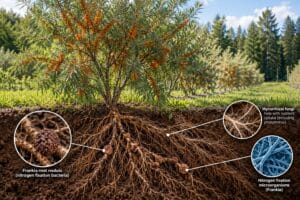
Sea buckthorn develops an extensive root system that spreads both horizontally and vertically.
Many lateral roots grow relatively close to the soil surface, while others extend deeper to provide anchorage and access to water. Research has documented substantial root development within the upper 40 cm of soil. [1]
These lateral roots can produce new shoots several metres away from the original shrub.

Sea buckthorn’s shallow lateral roots can produce new shoots beyond the original shrub, allowing the plant to gradually expand into surrounding areas.
Root suckering is a natural growth characteristic that helps sea buckthorn colonise suitable environments.
Although the plant can also reproduce through seeds, vegetative spreading through root suckers is generally the more noticeable concern around established plantings.
Root damage caused by digging, trenching or cultivation may also encourage additional suckering. Avoiding unnecessary disturbance around established plants can therefore be helpful.
Where Is Sea Buckthorn Most Likely to Become Invasive?
Sea buckthorn thrives in sunny, well-drained environments, particularly sandy soils where many other plants struggle to establish.
Its ability to grow in challenging conditions is an agricultural advantage, but it can also contribute to unwanted spreading.
Coastal Sand Dunes and Open Fields
In parts of Great Britain, sea buckthorn has formed dense, thorny thickets in coastal sand dunes, competing with native vegetation and altering open habitats.
Andrejs Brūvelis, PhD agronomist and sea buckthorn breeder with more than 40 years of cultivation experience, explains:
“We should always keep in mind that they talk about wild stands exclusively on sand dunes, where [sea buckthorn] is able to compete with other species due to humble growing requirements.”
His observation highlights an important distinction between unmanaged wild populations and maintained agricultural plantings.
However, sea buckthorn has also escaped cultivation in parts of Canada, including Ontario, where it is recognised as a potential invasive concern. [2]
Abandoned Orchards and Unmanaged Land
Sea buckthorn suckers can develop into established shrubs when left undisturbed.
Over time, neglected orchards or open fields containing sea buckthorn may develop dense stands of intertwined, thorny vegetation.
In contrast, maintained orchards typically control unwanted shoots through regular mowing.
Small Gardens and Property Boundaries
Sea buckthorn may also become troublesome in residential settings, particularly when planted close to neighbouring properties, ornamental gardens or areas that cannot be regularly mowed.
Because its roots can extend beyond the visible canopy, new shoots may emerge outside the original planting area.
Allowing adequate space and planning for ongoing maintenance can help prevent these problems.

How to Control Sea Buckthorn Root Suckers
Fortunately, controlling sea buckthorn’s spreading growth doesn’t have to be complicated.
The most practical method depends on the size of the planting, surrounding vegetation and accessibility.
1. Regular Mowing
Regular mowing is one of the simplest and most effective ways to manage sea buckthorn root suckers.
As new shoots emerge from underground roots, they are cut down along with the surrounding grass.
Consistent mowing prevents these shoots from developing into mature, woody shrubs.
This approach is particularly convenient in commercial orchards, grassy rows and residential lawns where mowing is already part of regular maintenance.
Although mowing does not eliminate the underground roots, it prevents unwanted above-ground growth from becoming established.
Cut suckers while they are still small and avoid damaging the main trunks or exposed roots with mowing equipment.
2. Manually Removing Unwanted Shoots
For smaller gardens or areas inaccessible to a mower, individual suckers can be removed with pruning shears.
Cut emerging shoots as close to their point of origin as practical, preferably while they are young and tender.
Because the roots remain alive, new growth may continue to appear. Inspect the area periodically throughout the growing season and remove unwanted shoots before they become woody and thorny.
3. Installing Underground Root Barriers
Root barriers may be useful in smaller orchards or gardens where sea buckthorn grows near property boundaries or landscaped areas.
Installed vertically below ground, these barriers help restrict the outward expansion of lateral roots.
However, sea buckthorn roots may extend beneath shallow barriers or grow around their ends.
Root barriers should therefore be considered an additional management tool rather than a guaranteed solution.
Installing barriers before planting is generally easier than working around an established root system.

Can Natural Growing Conditions Limit Sea Buckthorn Spreading?
Sea buckthorn strongly prefers full sunlight and well-drained soil.
These growing requirements can naturally restrict its expansion into less favourable environments.
Dense shade: Areas beneath mature trees or surrounded by taller, established vegetation may discourage suckers from developing into vigorous shrubs. Competition for light, water and nutrients can further limit growth.
Wetlands and poorly drained soils: Sea buckthorn does not tolerate prolonged flooding or persistently waterlogged conditions. Naturally wet areas may therefore restrict its establishment.
Neither condition guarantees that roots cannot spread into surrounding soil, but both can influence where new shrubs successfully develop.
When planning a planting, consider surrounding vegetation and natural landscape features. Avoid planting sea buckthorn near ecologically sensitive habitats where unwanted establishment could become problematic.
What About Companion Planting in Food Forests?
Sea buckthorn is sometimes included in permaculture gardens and food forests because of its nitrogen-fixing abilities and tolerance for poor soils.
However, its shallow, spreading roots require consideration when selecting neighbouring plants.
Repeated digging or cultivation around established shrubs may damage roots and encourage additional suckering.
Whenever possible, establish companion plants at the same time as sea buckthorn, choose perennials requiring minimal soil disturbance and allow sufficient space for root expansion.
As a food forest matures, increasing shade from neighbouring trees may naturally restrict sea buckthorn’s growth. However, excessive shade can also reduce the shrub’s vigour and berry production.
Frequently Asked Questions
How far can sea buckthorn roots spread?
Sea buckthorn can develop lateral roots extending several metres from the main trunk. The distance varies with plant age, soil conditions and growing environment.
Will mowing root suckers harm the parent shrub?
Regular mowing of young suckers should not significantly harm a healthy, established shrub, provided its trunk and larger roots are protected from mechanical damage.
Does mulch prevent sea buckthorn from spreading?
No. Although mulch suppresses weeds and conserves moisture, root suckers can emerge through ordinary mulch layers. Regular mowing or manual removal is more reliable.
Is sea buckthorn the same as invasive common buckthorn?
No. Sea buckthorn (Hippophae rhamnoides) and common buckthorn (Rhamnus cathartica) are different species with distinct growth characteristics and ecological impacts.
Final Thoughts: Is Sea Buckthorn Invasive or Simply Vigorous?
Sea buckthorn can spread aggressively in favourable environments, particularly where root suckers are allowed to develop without competition or maintenance.
However, this does not mean every sea buckthorn planting will become invasive.
For most maintained gardens and commercial orchards, regular mowing and early removal of unwanted shoots are practical ways to keep spreading under control.
Thoughtful site selection, adequate growing space and occasional inspections can further reduce unwanted growth.
Sea buckthorn’s root system is an important part of its adaptability, but understanding and managing that growth is essential to responsible cultivation.
For more information about planting, soil requirements and orchard management, read our Growing Sea Buckthorn 101 guide.
References
Turekhanova, R. (1996). Root system formation of Hippophae rhamnoides L. (seabuckthorn). Acta Phytogeographica Suecica, 81, 57–58. Shah, S. R. (2015). Root system of seabuckthorn (Hippophaë rhamnoides L.): morphology, metabolism and gene expression.
Ontario Invasive Plant Council. (2020). Grow Me Instead: A Guide for Southern Ontario, 3rd edition.