
Can Sea Buckthorn Grow in Clay Soil?
Sea buckthorn hates wet feet.
That’s the starting point.
Heavy clay soil drains slowly. When drainage is slow, roots sit in water longer than they should. And when roots sit in water, they lose access to oxygen. That’s the real issue with clay soil — not fertility, not nutrients — oxygen.
Clay compacts easily. As it compacts, the larger air-filled pores (macropores) disappear. With fewer macropores, oxygen diffusion drops. Roots begin to stress. Over time, stressed roots mean weaker growth, reduced anchorage, and eventual decline.
Sea buckthorn is tough. It tolerates cold, wind, and marginal soils remarkably well.
But it is not a swamp plant.
If you’re planting in clay soil, the goal isn’t simply to amend the surface or dig a generous hole. The goal is to design a root zone that stays aerated — even during spring thaw or after prolonged rain.
That’s where good planning makes all the difference.
Designing Root Stability in Clay Soil
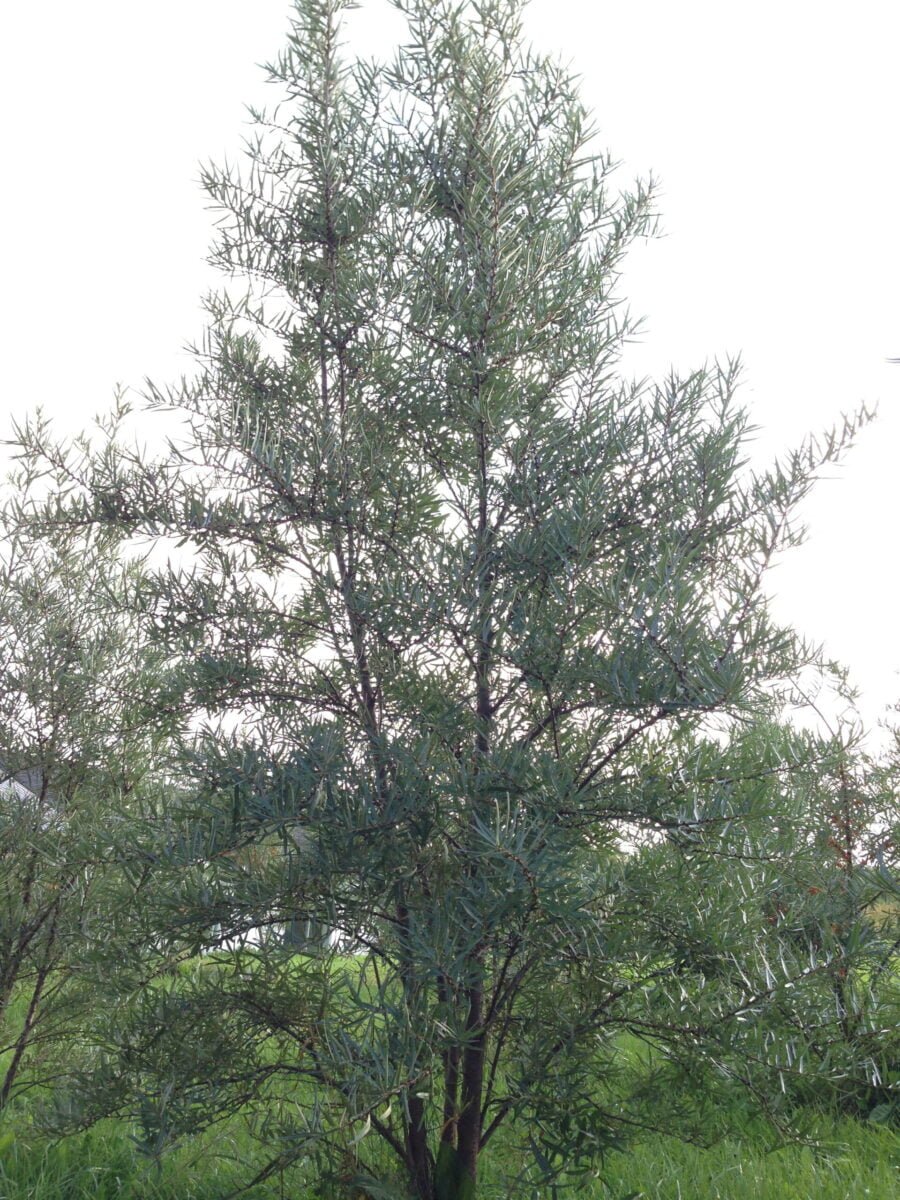
Sea buckthorn is not a small shrub. At maturity, it commonly reaches 3–4.5 m (10–15 ft) tall. That’s a significant amount of canopy and wind load.
Sea buckthorn also spreads through aggressive lateral roots. Those roots can extend 100–150 cm (40–60 inches) from the trunk within the first several years — especially in well-aerated soil.
So when planting in clay, you are not just solving drainage.
You are designing:
Anchorage
Oxygen access
Long-term root expansion
Wind stability
If you only improve the planting hole, you create a bathtub. Water collects in that amended pocket and drains poorly into the surrounding clay.
Instead, improve a continuous zone.
How to Improve Clay Soil Across the Entire Row
For clay sites, I recommend improving at least 90–150 cm (36–60 inches) wide along the row.
Incorporate amendments 30–40 cm (12–16 inches) deep at minimum. If equipment allows, deep ripping to 40–60 cm (16–24 inches) makes a noticeable difference in long-term stability.
If you are adding sand, it must be coarse — and always combined with compost. Fine sand alone in clay can create something closer to concrete than loam.
The key is gradual transition. Roots should move from improved soil into native clay naturally, not hit a hard wall.
Raised Rows in Clay Soil: Make Them Wide and Stable
I often see narrow berms recommended for clay. They help drainage in the short term, but for a tall woody shrub, narrow ridges aren’t enough.
Think broad and stable.
For production systems in heavy clay, I prefer:
Height: 40–50 cm (16–20 inches)
Base width: 120–150 cm (48–60 inches)
Flat planting zone on top: 45–75 cm (18–30 inches)
A wide base allows roots to expand laterally before encountering dense clay. It also increases wind stability and reduces erosion along the slopes.
Avoid steep-sided mounds. Gentle slopes integrate better with the surrounding soil and reduce exposure over time.
You’re building a foundation for a 10–15 ft shrub. Design accordingly.

Drainage Systems in Clay Soil: When Raised Rows Aren’t Enough
Raised rows improve surface drainage. But if excess water has nowhere to go, elevation alone won’t solve the problem.
Clay soil drains slowly at depth. Even if the surface looks dry, the subsoil may remain saturated after heavy rain or spring thaw.
If water routinely lingers for more than 48 hours, or if the water table sits within 60 cm (24 inches) of the surface, drainage planning becomes essential.
There are two different issues to consider:
Surface drainage
Water pooling in low spots
Poor grading
Depressions between rows
Subsurface drainage
Saturated clay layers
High water table
Slow internal water movement
Raised rows help with surface water.
Drainage systems address subsurface water.
For larger plantings, subsurface tile drainage can dramatically improve clay soil performance. Perforated tile installed below the root zone — typically 75–120 cm (30–48 inches) deep — helps move excess water away from planting rows and improves oxygen availability.
In heavy clay soil, tile spacing may range between 6–12 m (20–40 ft) depending on slope and density.
If full tile drainage isn’t practical, perimeter French drains or gentle grading (even a 1–2% slope) can significantly improve water movement.
The goal is movement, not dryness.
Clay soil doesn’t need to drain fast.
It just needs water to keep moving.
Suckering Behaviour in Clay Soil
Sea buckthorn spreads through its roots. That’s part of its nature.
In well-aerated soil, lateral roots move confidently. On a broad raised row, expect suckers to appear along the slopes as roots expand.
This isn’t a problem — it’s a sign of vigour.
In orchard systems, you’ll likely remove suckers annually. In shelterbelts, they can actually improve density.
Plan a clear management band around each plant, at least 40–60 cm (16–24 inches) wide. Repeated mowing of suckers along the berm edge can disturb the soil surface and increase erosion risk. Establishing a dense, low-growing cover crop helps bind the soil with fine roots, reduce runoff, and protect the berm from washout.
Design for management, not perfection.
Wind Stability Challenges in Clay Soil
A 4 m (13 ft) shrub in saturated clay can lean if the root system is shallow.
Risk increases when:
The water table is within 60 cm (24 inches) of the surface
Berms are narrow
Soil transition is abrupt
Clay holds moisture well — which is an advantage during dry periods — but after prolonged rain, it becomes heavy and anaerobic. Roots need oxygen as much as they need fertility.
If you are on acreage and water routinely lingers, raised rows alone may not be enough. Tile drainage, gentle grading (1–2% slope), or deeper ripping may be necessary.
Sometimes the best solution is improving the entire row strip rather than building a tall mound.

When Clay Soil Is Too Wet for Sea Buckthorn
Sea buckthorn can tolerate challenging conditions, but it should not sit in standing water.
If your site:
Holds water for days after rainfall
Has pure, dense gumbo clay
Has a consistently high water table
Then redesign the system before planting.
It is far easier to correct drainage before shrubs are established than after they are leaning.
Making Clay Soil Work for Sea Buckthorn
Sea buckthorn is tough. It handles cold, wind, and marginal soils remarkably well.
But clay requires intention.
Improve the oxygen.
Widen the root zone.
Design for lateral spread.
Think about wind before you plant.
Small design adjustments at the beginning often determine whether your planting thrives or struggles.
Clay soil can absolutely support healthy, productive sea buckthorn — when it’s designed intentionally. The key is respecting how the roots behave and giving them the space and oxygen they require.
For practical guidance on clay soil structure, compaction, and drainage in Canadian agricultural settings, see the Ontario Ministry of Agriculture, Food and Rural Affairs (OMAFRA) soil management resources.